
Most AEO advice tells you to write one clear H1, add FAQ schema, and structure your page for AI extraction. All true. Almost none of it explains why so many sites do exactly that and still never get quoted. The honest answer is simpler and less technical than the checklists suggest: most pages still don’t actually answer the question. They circle it, qualify it, and bury the point three paragraphs down, and no amount of schema fixes that.
This guide covers the structural side of answer engine optimization, your H1, your FAQ section, your schema, but it starts from that uncomfortable observation, because structure without a direct answer underneath it is just well-organized vagueness. If you want the broader picture of how search is changing, see our look at SEO and digital marketing in the AI era.
Why most AEO structure advice doesn’t work in practice
Here’s the pattern across a lot of sites that have technically “done AEO”: a question-shaped H2, FAQPage schema in the head, a single H1, and then, underneath all of that correct structure, two paragraphs of throat-clearing before the actual answer shows up. The schema is valid. The heading is fine. The content still doesn’t get cited, because an AI system extracting a passage needs the answer in the first few sentences, not after the setup.
This is the gap between following a checklist and actually getting to the point. A page can satisfy every item on an AEO audit and still fail the only test that matters: could a model lift one sentence out of this section and have it stand alone as a complete, correct answer? If the honest answer is no, the structure is decorative.
The real reason your pages get fetched but not quoted
This isn’t just a feeling, there’s data behind it. LoudFace’s audit of roughly 97,000 retrievals and 64,000 citations across B2B buyer prompts found that a page from a company website earned a citation only 61% of the times an AI system actually pulled it up. Reference material like documentation and encyclopedic sources converted at 89%, and community content like Reddit threads converted at 84%.

Source: LoudFace, The Complete Guide to AEO (2026).
Read that gap carefully. The engine already found the corporate page. It read it. It chose to quote something else instead. That’s not a crawlability problem or a ranking problem, it’s a structure problem: company pages are harder to lift a clean, self-contained sentence out of, because company pages are written to build a case, not to answer a question on the spot. If you’re rebuilding your core pages with this in mind, our guide to building a high-performing business website is a good starting point.
Write one intent-driven H1 per page
Your H1 is the first structural signal an answer engine uses to decide whether a page matches a query at all. A vague or clever H1 fails that check before the page is ever read in full.
The fix is naming the exact outcome or question the page addresses, not a brand-first headline or an abstract phrase. “Our Approach” tells an AI system nothing about what’s inside. “How to reduce churn in a usage-based SaaS product” tells it exactly what question this page answers and what query it should be matched against.
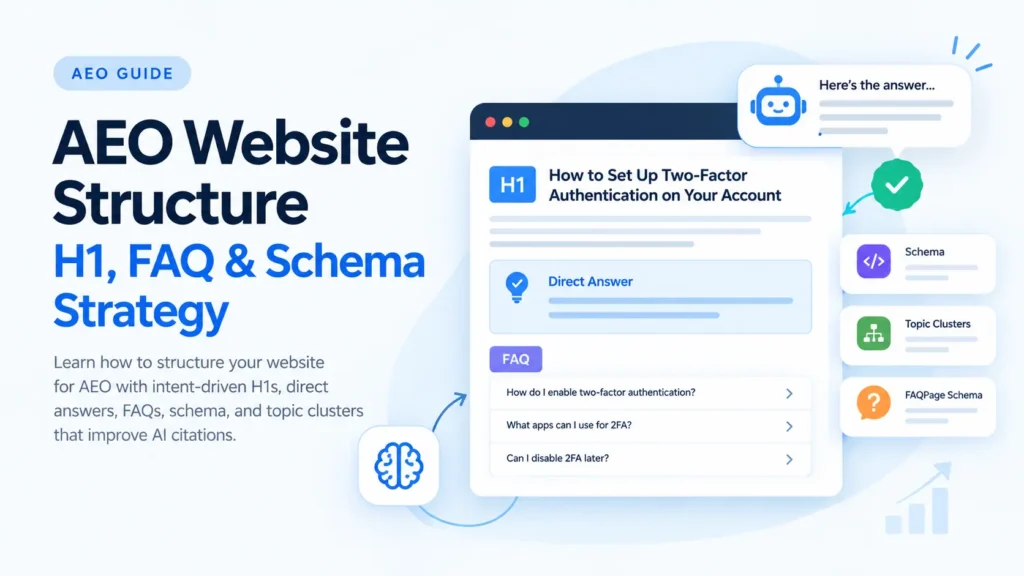
Weak vs. strong H1, in practice: “Getting Started” tells a reader and a model nothing. “How to set up two-factor authentication on your account” states the exact outcome. The second version can be matched against a real query; the first can only be matched against curiosity.
Put the direct answer in the first 40 to 60 words
This is the single highest-leverage structural change on this list, and it’s the direct fix for the “doesn’t get to the point” problem. After your H1 and after every question-style H2, the very next sentence should be a complete, self-contained answer, not a lead-in to one.
A useful test: if a model quoted only that first sentence and nothing else on the page, would it fully answer the question? If the real answer only becomes clear three sentences later, that’s the sentence getting cut, and a competitor’s page that answers immediately gets quoted instead.
Structure FAQs so each answer stands alone
An AEO FAQ section is not a general help page. Every answer has to make sense with zero surrounding context, because that’s exactly how it gets extracted, pulled out on its own and dropped into a generated response.
- Keep answers to 2 to 4 sentences. Roughly 40 to 80 words is the sweet spot, long enough to be complete, short enough to stay extractable.
- Lead with the conclusion. State the answer first, then add the one sentence of context that supports it.
- Use real questions. Pull them from search console queries, support tickets, and sales objections, not invented “What makes us different” filler nobody actually asks.
- Place FAQs after the main content, unless the question is a decision-blocker like pricing or eligibility, in which case it earns a spot higher up the page.
Mark up what you wrote with schema, don’t let schema replace the writing
FAQPage schema tells search engines and AI systems that a page contains structured question-and-answer content, which makes those answers far easier to identify and extract. But schema describes content, it doesn’t fix content, mismatched or hollow schema erodes trust rather than building it.
The non-negotiable rule: the visible answer and the schema version have to match exactly. Here’s a minimal, compliant example:
{
  "@context": "https://schema.org",
  "@type": "FAQPage",
  "mainEntity": [
    {
      "@type": "Question",
      "name": "How long should an AEO FAQ answer be?",
      "acceptedAnswer": {
        "@type": "Answer",
        "text": "Most AEO FAQ answers work best at 40 to 80 words across 2 to 4 sentences, written so the answer stands alone without needing the rest of the page for context."
      }
    }
  ]
}
Pair FAQPage with Article schema (author, publisher, datePublished, dateModified) on guides and blog posts, and Organization schema sitewide so your brand identity is machine-readable wherever it’s mentioned.
Build topic clusters, not isolated pages
One well-structured page helps. A connected set of pages covering the same subject from different angles gives an answer engine far more reason to treat your site as an authority on the topic, rather than a single lucky match for one query.
A topic cluster works the same way here as it does for traditional SEO: one hub page on the broad subject, linked to narrower supporting pages, with internal links running both directions. The difference in 2026 is that this structure also signals canonical-answer status to AI crawlers, not just search engines.
A quick AEO structure audit
| Check | Pass condition |
|---|---|
| H1 | One per page, states the exact question or outcome, no brand-first or vague phrasing |
| Opening answer | Direct answer within the first 40-60 words, no throat-clearing first |
| Headings | H2s and H3s phrased as real questions, each followed immediately by its answer |
| FAQ section | Self-contained 40-80 word answers, real user questions, schema matches visible text exactly |
| Schema | FAQPage and Article schema present and validated, no mismatched or hidden content |
| Rendering | Content visible in raw HTML, not dependent on client-side JavaScript rendering (see our technical SEO checklist) |
| Internal links | Page connects to and from related content in the same topic cluster |
Frequently asked questions
Q. What website structure works best for answer engine optimization?
Ans: An answer-first structure with one intent-driven H1, question-style H2s followed immediately by direct answers, a concise FAQ section backed by FAQPage schema, and internal links connecting the page into a broader topic cluster.
Q. How long should an AEO FAQ answer be?
Ans: Most answers work best at 40 to 80 words across 2 to 4 sentences, self-contained enough that an AI system can extract and reuse them without needing the rest of the page for context.
Q. Does FAQPage schema actually improve AI citations?
Ans: It makes your FAQ content easier for AI systems to identify and extract reliably, but schema only describes content that’s already clear and self-contained. Schema on a vague or buried answer won’t make that answer citable.
Q. Should every page have an FAQ section?
Ans: No. FAQs work best on high-intent pages where users have specific, decision-shaping questions. Adding generic FAQs to every page dilutes topical clarity rather than strengthening it.
Q. Why do company websites get cited less than community content?
Ans: Data from a large-scale citation audit found company pages earn a citation in only about 61% of the times an AI system retrieves them, compared to roughly 84-89% for community and reference content, largely because company pages are written to build a case rather than answer a question in one self-contained sentence.