For most businesses, having a website is no longer enough. Customers don’t just visit a site because they know it exists, they find it through search engines, social media, AI-powered answers, and paid ads. SEO and digital marketing are the two forces that determine whether your business shows up in those moments or stays invisible. This blog breaks down what each of these actually means, how they work together, and why relying on just one is no longer a sustainable growth strategy.
Stop Guessing Your Growth Strategy
Is your website losing valuable traffic to competitors right now? Don’t let potential customers pass you by. Explore TechXaro’s integrated SEO & Digital Marketing Services today and claim your Free Growth Strategy Audit to find exactly where your hidden revenue is hiding.
This comprehensive guide breaks down what each of these strategies actually means, how they work together, and why relying on just one is no longer a sustainable growth plan in today’s competitive landscape.
What Is SEO?
SEO, or Search Engine Optimization, is the practice of improving a website so it ranks higher in search engine results for relevant queries. It covers everything from technical site structure and page speed to keyword research, content quality, and backlinks from other reputable websites.
SEO is a long-term strategy. Rather than paying for visibility, you’re earning it by making your website more relevant, trustworthy, and useful than competing pages. According to Google’s own Search Central documentation, the fundamentals of good SEO haven’t changed much: quality content, clear site structure, and technical accessibility remain at the core of how search engines evaluate websites.
The Three Pillars of SEO
Most SEO strategies are built around three core areas:
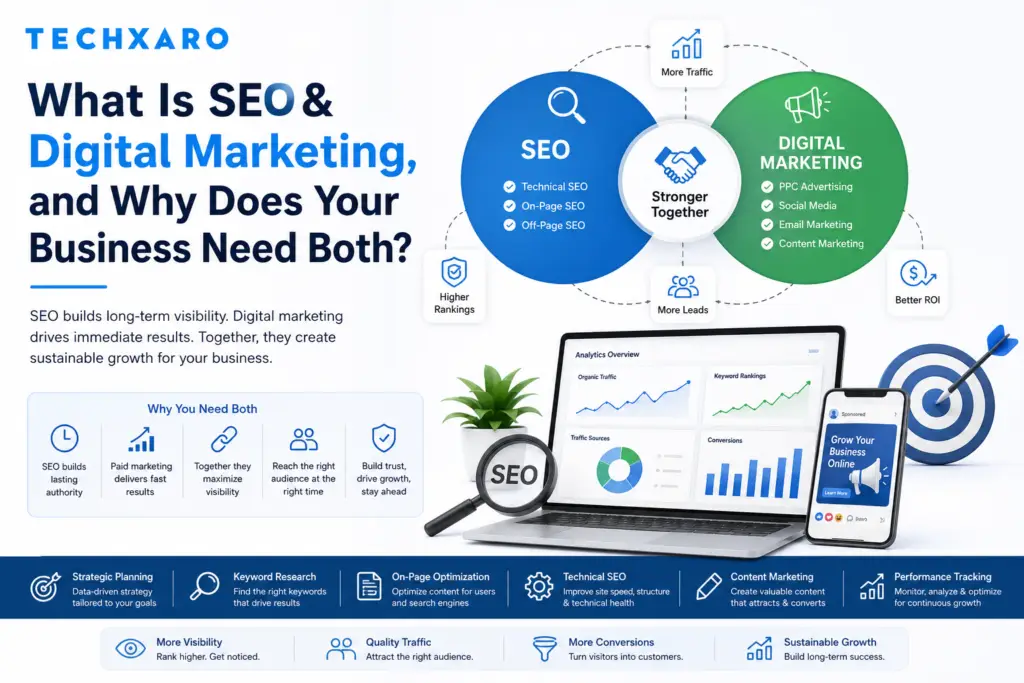
- Technical SEO: site speed, mobile-friendliness, indexing, and structured data (schema markup)
- On-Page SEO: Content quality, keyword targeting, headings, and internal linking
- Off-Page SEO: Backlinks, brand mentions, and overall domain authority
What Is Digital Marketing?
Digital marketing is the broader umbrella that includes SEO, but also extends into paid advertising, social media, email campaigns, and content marketing across multiple channels. While SEO focuses on organic (unpaid) visibility, digital marketing includes both organic and paid strategies working toward the same goal: getting your brand in front of the right audience at the right time.
Digital marketing channels typically include:
- Pay-Per-Click (PPC) advertising on Google and social platforms
- Social media marketing and community management
- Email marketing and automated nurture campaigns
- Content marketing across blogs, video, and other formats
Businesses looking to strengthen online visibility should also explore how digital marketing and SEO drive web traffic for long-term growth.
How SEO and Digital Marketing Work Together
SEO and digital marketing aren’t competing strategies; they’re complementary parts of the same growth engine. SEO builds long-term, sustainable visibility, while digital marketing channels like PPC and social media generate faster, more immediate results.
| Factor | SEO | Digital Marketing (Paid/Social) |
| Speed of results | Slower (months) | Faster (days to weeks) |
| Cost over time | Lower long-term cost | Ongoing ad spend required |
| Visibility type | Organic, earned | Paid or algorithm-driven |
| Sustainability | Compounds over time | Stops when budget stops |
| Best for | Long-term brand authority | Immediate traffic and promotions |
| Trust factor | Higher (users trust organic results) | Lower (perceived as ads) |
When used together, paid campaigns can drive immediate traffic while SEO builds the foundation that keeps generating leads long after a campaign ends.
Bridge the Gap Between Traffic and Revenue
Driving traffic is only half the battle converting those visitors into paying customers is where the real revenue happens. At TechXaro, we don’t just build visibility; we build conversion funnels. See how our tailor-made SEO & Digital Marketing Solutions can turn your website into a 24/7 lead-generation machine.
Get Your Free Conversion Strategy Session
Why Your Business Needs Both, Not Just One
Relying Only on SEO Leaves Gaps
SEO takes time to show results, often three to six months or more before meaningful ranking improvements appear. If your business needs visibility now for a product launch, seasonal promotion, or new market entry SEO alone won’t move fast enough.
Relying Only on Paid Marketing Is Expensive Long-Term
Paid ads stop generating traffic the moment you stop paying. Without SEO working in the background, every new customer comes at an ongoing cost, and your business never builds the organic foundation that reduces dependency on ad spend over time.
Search Itself Is Changing
Search behavior is shifting beyond traditional Google results. AI-powered tools and generative search experiences are increasingly answering queries directly, which means businesses now need to think about how they’re cited and represented across AI models, not just in traditional search rankings. This emerging discipline, often referred to as AI Engine Optimization (AEO) or Generative Engine Optimization (GEO), is becoming a critical part of modern SEO strategy.
Discover how businesses are adapting to AI-driven search in the AI era of SEO and digital marketing.
A Combined Strategy Builds Compounding Growth
When SEO and digital marketing work together, content created for SEO can be repurposed for social media and email campaigns, paid campaign data reveals which keywords and audiences convert best (informing SEO strategy), and brand visibility across multiple channels reinforces trust signals that search engines use to evaluate authority.
Building an Integrated SEO & Digital Marketing Strategy
A strong strategy typically follows a structured path:
- Audit: Assess your current SEO performance, technical health, and existing marketing channels against competitors.
- Strategy & Content Planning: Map out content clusters and campaigns based on what your audience is actually searching for.
- Technical Foundation: Fix site speed, structure, and schema markup so search engines (and AI models) can understand your site clearly.
- Authority Building: Earn backlinks, mentions, and PR coverage that build long-term domain trust.
- Paid Amplification: Use PPC and social ads to accelerate visibility while organic strategies mature.
- Continuous Optimization: Regularly review performance data and adjust based on algorithm changes and audience behavior.
This is the same integrated approach outlined in TechXaro’s SEO & Digital Marketing Services, which combines technical SEO, AI search visibility, and full-funnel marketing into a single strategy rather than treating each channel in isolation. If your website also needs performance improvements, explore our guide on building a high-performing business website to strengthen your digital foundation.
Frequently Asked Questions
Is SEO still relevant with the rise of AI search tools?
Yes. AI-powered search experiences still rely on well-structured, authoritative content to generate their answers. Strong SEO fundamentals, including clear site structure and quality content, directly influence whether your brand gets cited by AI models, making SEO arguably more important, not less.
How long does SEO take to show results?
Most businesses begin seeing measurable improvements within three to six months, though this varies based on competition, industry, and the current state of the website. SEO is a cumulative process; results tend to build and compound over time rather than appearing instantly.
What’s the difference between SEO and PPC?
SEO focuses on earning organic rankings through content, technical optimization, and authority building, with no direct cost per click. PPC involves paying for ad placements that appear immediately but stop generating traffic once the budget is exhausted.
Can a small business benefit from both SEO and digital marketing?
Yes. Small businesses often benefit the most from a combined approach, using PPC or social ads for immediate visibility while SEO builds a foundation that reduces long-term reliance on advertising costs.
What is AEO and GEO, and why does it matter?
AEO (AI Engine Optimization) and GEO (Generative Engine Optimization) refer to optimizing content so it’s accurately represented and cited by AI tools and generative search experiences. As more users get answers directly from AI models, ensuring your brand is recognized as a trusted source becomes an extension of traditional SEO.
How do I know if my current digital marketing strategy is working?
Key indicators include organic traffic growth, keyword ranking improvements, conversion rates from paid campaigns, and overall return on ad spend (ROAS). Regular reporting and analysis are essential to understanding which channels are driving real business results.
Ready to Scale Your Digital Footprint?
Don’t let a disjointed marketing strategy stall your business growth. Let’s integrate your search visibility, paid amplification, and conversion design into a unified, high-yielding strategy.
Get Your Free Strategic Consultation & Site Audit Now and work with TechXaro to turn your traffic into measurable revenue.
