
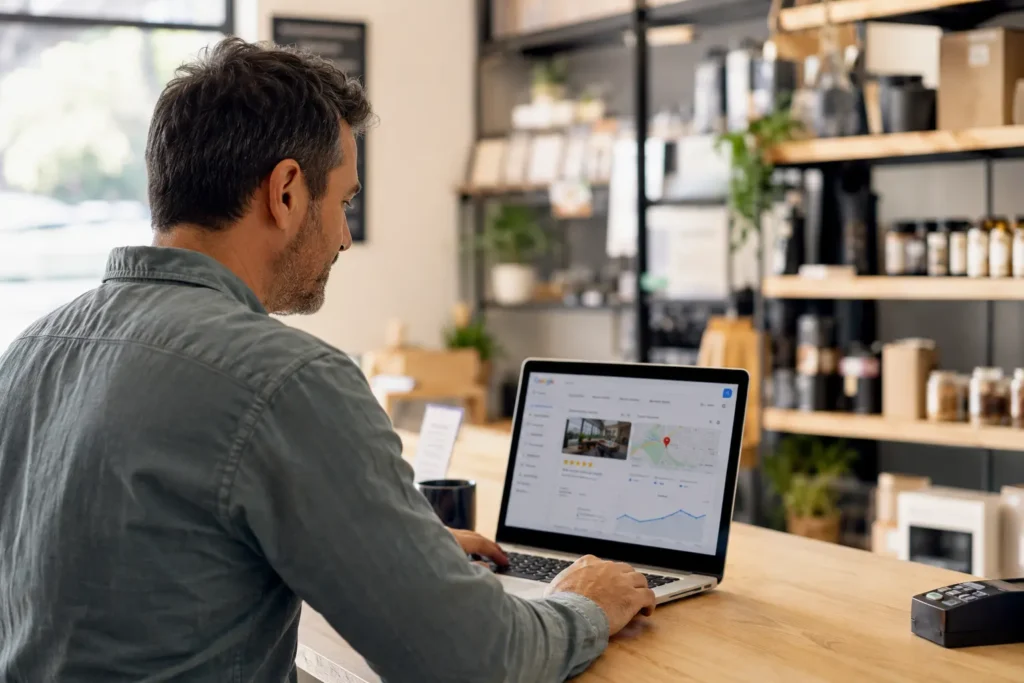
Local SEO for small businesses means optimizing your Google Business Profile, website, and online reputation so you show up when nearby customers search for what you offer, on Google Maps, in the Local Pack, and increasingly, in AI-generated answers too. It’s the single highest-leverage marketing channel most small businesses have access to: 46% of all Google searches carry local intent, and 78% of local mobile searches lead to an offline visit within 24 hours. I’ve put together everything I actually check and fix when I run a local SEO strategy for a client, step by step, below.
If you’ve ever searched for your own business and found a competitor sitting above you in the map results, this guide is for you. I’ll cover the fundamentals, a real self-audit you can run today, and where local SEO is actually heading in 2026.
What Is Local SEO, and How Is It Different From Regular SEO?
Local SEO is the subset of SEO focused on ranking your business for searches tied to a specific geographic area, “plumber in Brooklyn,” “coffee shop near me,” “dentist open now.” Regular SEO cares about ranking a page anywhere in the world; local SEO cares about ranking your business for the people who can actually walk through your door or drive to you.
The clearest sign of this difference is the Local Pack (also called the Map Pack), the block of three business listings with a map, star ratings, and a call button that shows above regular search results for local queries, powered by your Google Business Profile. Businesses that land in the Local Pack get 126% more traffic, and 93% more actions (calls, clicks, direction requests) than businesses ranked 4-10, according to recent local search data. That’s not a small edge; it’s the difference between being found and being invisible.
Why Does Local SEO Matter So Much for Small Businesses?
The numbers here are genuinely hard to ignore once you see them together.
Source: BrightLocal, BizIQ, SeoProfy local search research, 2026.
| Local intent share |
|
46% | ||
| Local Pack CTR |
|
42% | ||
| Offline visit within 24 hrs |
|
78% |
Source: BrightLocal, Think with Google local search research, 2026.
That last row is the one I point clients to most often: 78% of local mobile searches result in a real, physical visit within a day. This isn’t a channel that generates vague brand awareness; it drives people to your actual door, usually the same day they searched. And per Think with Google’s own research, that behavior has only gotten stronger as mobile search has become the default way people find local businesses at all.
The flip side of these numbers is the opportunity gap: over half of small businesses still haven’t fully optimized their Google Business Profile, and a large share have inconsistent business information across the directories that feed into local rankings. That gap is exactly where the businesses that do this well pull ahead, not through some secret tactic, just through consistent, complete execution of the fundamentals.
How Do I Claim and Optimize My Google Business Profile?
This is the single highest-leverage thing on this entire list, and it’s free. Your Google Business Profile (GBP) directly controls whether you show up in the Map Pack, and Google Business Profile signals alone account for roughly 32% of total Local Pack ranking weight, more than any other single factor.

Here’s what actually moves the needle, based on what consistently separates the top-ranked profiles from the rest:
| ✓ | Claim and verify your listing through Google Business Profile Manager if you haven’t already; verification is usually done by postcard, phone, or email depending on your business type |
| ✓ | Choose your primary category carefully; it’s one of the top-weighted individual ranking signals, more influential than most business owners realize |
| ✓ | Complete every section, including the business description; 75% of businesses holding a top-3 Local Pack position have a fully completed description, compared to a much smaller share of lower-ranked listings |
| ✓ | Add real, current photos regularly; listings with strong photo counts consistently outperform sparse ones on engagement |
| ✓ | Keep hours accurate, including holiday hours, since Google has increasingly started factoring in whether a business is actually open right now for certain time-sensitive searches |
| ✓ | Use the Posts and Q&A features; most competitors leave these blank entirely, which makes them an easy, low-competition way to stand out |
A complete profile isn’t a nice-to-have here; it’s the difference between a listing that quietly exists and one that’s actually generating calls and direction requests. This is exactly the kind of foundational work I include in local SEO strategy work before anything else, since content and link building can’t compensate for a Google Business Profile that’s only half-filled out.
What Is NAP Consistency, and Why Does It Matter?
NAP stands for Name, Address, and Phone number, the core identifying details of your business. NAP consistency means those three details are identical, formatted the same way, everywhere your business is listed online: your website, your Google Business Profile, Yelp, Bing Places, industry directories, all of it.
This sounds like a small, mechanical detail, but it’s a real trust signal Google uses to confirm your business is legitimate and where it says it is. A meaningful share of small businesses, roughly 64%, have at least one NAP inconsistency across a major directory right now, usually something as small as “St.” on one listing and “Street” on another, or an old phone number that never got updated after a move.
Where to check and fix NAP consistency:
| ✓ | Your own website (header, footer, and contact page) |
| ✓ | Your Google Business Profile |
| ✓ | Major directories: Yelp, Bing Places, Apple Maps |
| ✓ | Industry-specific directories relevant to your business |
| ✓ | Your Chamber of Commerce or local business association listing |
| ✓ | Social media profiles (Facebook, Instagram, LinkedIn) |
I’ve actually run into this exact issue firsthand, auditing sites where the business name shifts slightly between the homepage footer and individual service pages, small enough that a person barely notices, but exactly the kind of inconsistency that makes Google less confident it’s looking at the same business across the web. The fix isn’t glamorous; it’s just going directory by directory and matching everything exactly, but it’s one of the most reliably effective things you can do since it removes doubt rather than adding a new ranking signal.
How Do Reviews Affect Local Rankings?
Reviews work on two separate tracks at once: they’re a direct local ranking factor, and separately, they’re one of the strongest conversion factors once someone actually finds you. Review signals account for roughly 16% of total Local Pack ranking weight, but their bigger impact might be on the human deciding whether to actually call you.

The numbers here are striking. Per BrightLocal’s Local Consumer Review Survey, 97-98% of consumers read reviews for local businesses before choosing one, and a meaningful share, 31%, will only use businesses with 4.5 stars or higher. Google Business Profiles with 50+ reviews get 4.4 times more clicks than profiles with under 5 reviews. Crossing that 50-review threshold isn’t a nice milestone; it’s genuinely one of the highest-leverage things a small business can do for both ranking and conversion at the same time.
| BaselineUnder 5 reviews; relatively low click rate performance baseline | 4.4x50+ reviews; more profile clicks than under-5-review profiles |
A review management strategy that actually works:
| ✓ | Ask happy customers directly, right after a positive interaction, not weeks later through a generic email blast |
| ✓ | Make it easy: a direct review link removes friction that stops people from following through |
| ✓ | Respond to every review, positive and negative, thoughtfully and promptly; this itself is a trust signal, not just good customer service |
| ✓ | Never buy or fake reviews; Google actively penalizes this, and it’s one of the fastest ways to lose a profile entirely |
| ✓ | Address negative reviews professionally and try to actually resolve the issue; a well-handled negative review often builds more trust than a page of five-star praise with no depth |
One thing I’d add that a lot of review advice misses: how you respond matters almost as much as the review itself, since anyone reading your reviews later is also reading your responses. A defensive or dismissive reply to a negative review can do more damage than the original complaint.
How Do I Build a Local SEO Content Strategy?
A strong local SEO content strategy isn’t about publishing more; it’s about publishing content that specifically demonstrates local relevance, something a national competitor with no presence in your area genuinely can’t replicate. This is where a lot of small businesses stop too early; they’ll optimize their Google Business Profile and call it done, without realizing content is what builds the topical and geographic authority behind that profile.
Content types that actually work for local SEO:
If you serve multiple areas, dedicated location pages matter more than most business owners expect; a single generic “Service Areas” page listing five cities in one paragraph does far less than five genuinely useful pages, each written for that specific area rather than duplicated with the city name swapped out. Google can tell the difference, and so can readers.
I’d also push back gently on one common piece of advice: content quantity for its own sake doesn’t help local rankings. A handful of genuinely useful, locally specific pages will outperform a large volume of thin, interchangeable posts every time. This is the same principle behind the pillar-cluster content structure I covered in our technical SEO guide: depth and genuine usefulness over raw volume.
How Do I Run a Local SEO Audit on My Own Website?
You don’t need expensive software to catch the most common local SEO problems yourself. Here’s the actual checklist I run through first, before touching anything more advanced.
A basic local SEO audit checklist:
| ✓ | Search your own business name on Google. Does your Google Business Profile show up correctly, with the right category, hours, and photos? |
| ✓ | Check your NAP consistency across your website, Google Business Profile, and at least the top 3-4 directories relevant to your industry |
| ✓ | Search “[your service] near me” or “[your service] in [your city]” from an incognito browser window and see where you actually land, not where you assume you land |
| ✓ | Review your Google Business Profile insights for views, calls, and direction requests over the last 90 days; a flat or declining trend is worth investigating |
| ✓ | Count your reviews and check your average rating against local competitors who are outranking you |
| ✓ | Confirm your website has location-specific content, not just a single generic “About Us” page with no geographic detail |
| ✓ | Check your site loads properly and quickly on mobile, since the majority of local searches happen on a phone |
| ✓ | Verify your NAP appears in your website’s footer on every page, not just the contact page |
| ✓ | Check for local business schema markup, and if you have it, confirm it’s only on the one page your Google Business Profile actually links to, not duplicated across every page |

This audit takes maybe 30-45 minutes to run manually, and it’ll surface the majority of issues actually holding a small business back. If you want a deeper, more technical version of this same process, it’s a good companion to run alongside the 15-point technical SEO checklist we published separately, since a handful of items overlap (schema, mobile speed, site structure) but this version is specifically tuned for local ranking factors.
Should You Hire an Agency, or Use a White Label SEO Provider?
This question splits into two different audiences, and it’s worth being clear about which one you are.
If you’re a small business owner deciding how to handle your own local SEO, the choice is really DIY versus hiring a b2b SEO agency directly. Everything covered in this guide- Google Business Profile optimization, NAP consistency, review management, content is genuinely doable in-house if you have the time and are willing to stay consistent with it. Where a dedicated agency tends to earn its cost is in the ongoing monitoring, the technical pieces (schema, site structure), and simply having someone accountable for staying on top of it when running the business itself is already a full-time job.
If you’re a marketing consultant, web design freelancer, or small agency yourself, and a client has asked you for local SEO work you don’t have the in-house capacity to deliver, this is where white label SEO comes in. A white label SEO agency or white label SEO company does the actual local SEO execution behind the scenes- GBP management, citation building, review strategy, reporting- while you stay the client-facing point of contact under your own brand. It’s a genuinely common model in this industry specifically because local SEO fulfillment is repetitive, process-driven work that scales well when handled by a specialized partner rather than built from scratch by every individual agency.
The through-line across all three options is the same: local SEO isn’t a one-time setup; it’s ongoing maintenance, whoever ends up doing it. That’s exactly why we treat it the same way we treat website maintenance, as a recurring commitment, not a project with a finish line.
How Is AI Changing Local Search?
This is the part of local SEO most existing guides haven’t caught up to yet, and it’s moving fast. AI assistants like ChatGPT, Gemini, and Perplexity are increasingly being asked directly for local business recommendations, “find me a good dentist nearby,” not just typed into a traditional Google search box.
A few things stand out from recent research into how this actually works right now:
| 1 | Businesses recommended by AI tools average 4.3 stars on ChatGPT, 4.1 on Perplexity, and 3.9 on Gemini, meaning your review profile still matters here, arguably even more than in traditional search |
| 2 | Only 68% of business contact information shown by ChatGPT and Perplexity actually matches what’s listed on Google Business Profile, a real accuracy gap that can send a customer the wrong address or a disconnected phone number |
| 3 | 21% of ChatGPT users still switch back to Google to verify a local recommendation before acting on it, so AI visibility doesn’t yet replace traditional local SEO; it sits alongside it |
FAQs
How long does local SEO take to show results?
Most small businesses see measurable movement within 3-6 months of consistent effort, similar to the timeline for broader SEO work. Google Business Profile changes tend to reflect fastest, sometimes within days to a couple of weeks, while content and review-driven ranking improvements build more gradually over time.
Do I need a physical storefront to do local SEO?
No, but it changes your approach. Service-area businesses without a public-facing address can still claim a Google Business Profile and rank in local results; they just won’t display a public address the way a storefront business does. The core fundamentals- reviews, NAP consistency, and local content- still apply.
Is local SEO worth it for a business that only serves one small town?
Often more so than for businesses in larger markets, since competition for local search terms tends to be lower in smaller areas, and the businesses that do invest in it consistently pull far ahead of ones that haven’t touched their Google Business Profile in years.
What’s the single biggest local SEO mistake small businesses make?
Treating their Google Business Profile as a one-time setup instead of something actively managed: no new photos, no responses to reviews, outdated hours. An incomplete or neglected profile at the same traffic level generates dramatically fewer actual calls and direction requests than a fully optimized one.
How is local SEO different from a “local seo near me” search specifically?
“Near me” searches are simply the clearest, most explicit form of local intent; someone typing “coffee shop near me” is telling Google exactly what they want with no ambiguity. Local SEO as a discipline covers this and the much larger set of searches that carry local intent without saying “near me” outright; Google now recognizes local intent in queries like “plumber” alone when someone’s on a mobile device with location services on.
Can I do local SEO myself, or should I hire someone?
Genuinely, yes, you can do the fundamentals yourself; this guide covers exactly what that looks like. Where people typically bring in outside help is either a lack of time to stay consistent, or wanting the technical pieces (schema, site structure, ongoing monitoring) handled by someone who does it full time. If you’re an agency rather than a business owner, that’s where an SEO partner usually enters the picture instead.
Bringing It All Together: Your Local SEO Checklist
Here’s every core action from this guide in one place, roughly in the order I’d tackle them.
Final Thoughts
If there’s one thing worth taking away from all of this: local SEO rewards consistency far more than cleverness. Every tactic here- GBP optimization, reviews, NAP consistency, local content- is publicly known and freely available. The businesses that actually pull ahead aren’t the ones who found some secret technique; they’re the ones who did the fundamentals properly and kept doing them, month after month, while their competitors let their profile go stale.
None of this requires a huge budget to start. It requires attention and a willingness to treat your online presence with the same care you’d put into your physical storefront.
Want to know exactly where your business stands in local search right now?
Our SEO & Digital Marketing team reviews your Google Business Profile, website, and local visibility, free, with a prioritized action plan.